E (musical note)
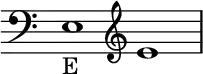
E is the third note and the fifth semitone of the C major scale, and mi in fixed-do solfège. It has enharmonic equivalents of F♭ [(F-flat) which is by definition a diatonic semitone above E♭] and D (D-double sharp), amongst others.
When calculated in equal temperament with a reference of A above middle C as 440 Hz, the frequency of Middle E (E4) is approximately 329.628 Hz.[1] See pitch (music) for a discussion of historical variations in frequency.
Designation by octave
| Scientific designation | Helmholtz designation | Octave name | Frequency (Hz)b | MIDI note number |
|---|---|---|---|---|
| E−1 | E͵͵͵ or ͵͵͵E or EEEE | Subsubcontra | 10.301 | 4 |
| E0 | E͵͵ or ͵͵E or EEE | Subcontra | 20.602 | 16 |
| E1 | E͵ or ͵E or EE | Contra | 41.203 | 28 |
| E2 | E | Great | 82.407 | 40 |
| E3 | e | Small | 164.814 | 52 |
| E4 | e′ | One-lined | 329.628 | 64 |
| E5 | e′′ | Two-lined | 659.255 | 76 |
| E6 | e′′′ | Three-lined | 1318.51 | 88 |
| E7 | e′′′′ | Four-lined | 2637.02 | 100 |
| E8 | e′′′′′ | Five-lined | 5274.041 | 112 |
| E9 | e′′′′′′ | Six-lined | 10548.082 | 124 |
| E10 | e′′′′′′′ | Seven-lined | 21096.164 | N/A |
Scales
Common scales in the key of E.
- E major: E F♯ G♯ A B C♯ D♯ E
- E natural minor: E F♯ G A B C D E
- E harmonic minor: E F♯ G A B C D♯ E
- E melodic minor ascending: E F♯ G A B C♯ D♯ E
- E melodic minor descending: E D C B A G F♯ E
E major modes (diatonic scales).
- E Ionian: E F♯ G♯ A B C♯ D♯ E
- E Dorian: E F♯ G A B C♯ D E
- E Phrygian: E F G A B C D E
- E Lydian: E F♯ G♯ A♯ B C♯ D♯ E
- E Mixolydian: E F♯ G♯ A B C♯ D E
- E Aeolian: E F♯ G A B C D E
- E Locrian: E F G A B♭ C D E
- E ascending melodic minor: E F♯ G A B C♯ D♯ E
- E Dorian ♭2: E F G A B C♯ D E
- E Lydian augmented: E F♯ G♯ A♯ B♯ C♯ D♯ E
- E Lydian dominant: E F♯ G♯ A♯ B C♯ D E
- E Mixolydian ♭6: E F♯ G♯ A B C D E
- E Locrian ♮2: E F♯ G A B♭ C D E
- E altered: E F G A♭ B♭ C D E
E harmonic minor modes
- E harmonic minor: E F♯ G A B C D♯ E
- E Locrian ♮6: E F G A B♭ C♯ D E
- E Ionian ♯5: E F♯ G♯ A B♯ C♯ D♯ E
- E Dorian ♯4: E F♯ G A♯ B C♯ D E
- E Phrygian ♮3: E F G♯ A B C D E
- E Lydian ♯2: E F G♯ A♯ B C♯ D♯ E
- E Superlocrian
 7: E F G A♭ B♭ C D♭ E
E harmonic major modes
- E Harmonic Major: E F♯ G♯ A B C D♯ E
- E Dorian ♭5: E F♯ G A B♭ C♯ D E
- E Phrygian ♭4: E F G A♭ B C D E
- E Lydian ♭3: E F♯ G A♯ B C♯ D♯ E
- E Mixolydian ♭2: E F G♯ A B C♯ D E
- E Lydian Augmented ♯2: E F G♯ A♯ B♯ C♯ D♯ E
- E Locrian 7: E F G A B♭ C D♭ E
F-flat
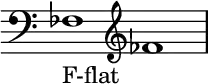
F♭ is a common enharmonic equivalent of E, but is not regarded as the same note. F♭ is commonly found after E♭ in the same measure in pieces where E♭ is in the key signature, in order to represent a diatonic, rather than a chromatic semitone; writing an E♭ with a following E♮ is regarded as a chromatic alteration of one scale degree.
References
- ^ Suits, B. H. (1998). "Physics of Music Notes - Scales: Just vs Equal Temperament". MTU.edu. Michigan Technological University. Archived from the original on 22 July 2017. Retrieved 5 February 2024.