Japanese counter word
In Japanese, counter words or counters are measure words used with numbers to count things, actions, and events. Counters are added directly after numbers.[1] There are numerous counters, and different counters are used depending on the kind or shape of nouns that are being described.[1] The Japanese term, josūshi (助数詞; lit. 'helping number word'), appears to have been literally calqued from the English term auxiliary numeral used by Basil Hall Chamberlain in A Handbook of Colloquial Japanese.[2][3]
In Japanese, as in Chinese and Korean, numerals cannot quantify nouns by themselves (except, in certain cases, for the numbers from one to ten; see below).[4] For example, to express the idea "two dogs" in Japanese one could say either:
二
ni
two
匹
hiki
small-animal-MW
の
no
POSS
犬
inu
dog
犬
inu
dog
二
ni
two
匹
hiki
small-animal-MW
but just pasting 二 and 犬 together in either order is ungrammatical. Here 二 ni is the number "two", 匹 hiki is the counter for small animals, の no is the possessive particle (a reversed "of", similar to the " 's" in "John's dog"), and 犬 inu is the word "dog".
Counters are not independent words; they must appear with a numeric prefix. The number can be imprecise: 何 nan or, less commonly, 幾 iku, can both be used to mean "some/several/many", and, in questions, "what/how many/how much". For example:
何
nan
some
名
mei
people-MW
様
sama
honored-ones
"some guests"
何
nan
what
名
mei
people-MW
様
sama
honored-ones
?
?
Q
"how many guests?"
Some nouns prefer 幾 iku, as in:
- 幾晩? iku-ban? "how many nights?"
- 幾日も行っていた iku-nichi mo itte ita "I was gone for many days."
Counters are similar in function to the word "pieces" in "two pieces of paper" or "cups" in "two cups of coffee". However, they cannot take non-numerical modifiers. So while "two pieces of paper" translates fairly directly as:
紙
kami
paper
二
ni
two
枚
mai
flat-MW
"two pieces of paper"
"two green pieces of paper" must be rendered as 緑の紙二枚 midori no kami ni-mai, akin to "two pieces of green paper".
Just as in English, different counters can be used to convey different types of quantity.
パン
pan
bread
一斤
ikkin
one-loaf
"one loaf of bread"
パン
pan
bread
一枚
ichimai
one-flat-MW
"one slice of bread"
There are numerous counters, and depending on the kind or shape of nouns the number is describing, different counters are used.[1]
Grammatically, counter words can appear either before or after the noun they count. They generally occur after the noun (following particles), and if used before the noun, they emphasize the quantity; this is a common mistake for English learners of Japanese. For example:
ビール
bīru
beer
を
o
OBJ
二本
nihon
two-long-thin-MW
飲んだ
nonda
drank
In contrast:
二本
nihon
two-long-thin-MW
の
no
POSS
ビール
bīru
beer
を
o
OBJ
飲んだ
nonda
drank
would only be appropriate when emphasizing the number as in responding with "[I] drank two bottles of beer" to "How many beers did you drink?".
Phrase structure involving numerals and counters
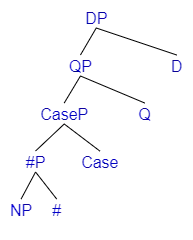
In generative grammar, one proposed structure of Japanese nominal phrases includes three layers of functional projections: #P, CaseP, and QuantifierP.[5] Here, #P is placed above NP to explain Japanese's lack of plural morphology, and to make clear the # head is the stem of such morphology.[5] This structure relies on movement in order to satisfy agreement via extended projection principle features.[5]
Substitution of counters
In Japanese, virtually all nouns must use a counter to express number because Japanese lacks singular/plural morphology.[6][5] In this sense, virtually all Japanese nouns are mass nouns. This grammatical feature can result in situations where one is unable to express the number of a particular object in a syntactically correct way because one does not know, or cannot remember, the appropriate counting word. With quantities from one to ten, this problem can often be sidestepped by using the traditional numerals (see below), which can quantify many nouns without help. For example, "four apples" is りんご四個 ringo yonko where 個 ko is the counter, but can also be expressed, using the traditional numeral four, as りんご四つ ringo yottsu. These traditional numerals cannot be used to count all nouns, however; some, including nouns for people and animals, require a proper counter (except for 1 and 2 people, which virtually always use variants of the traditional numerals; see exceptions).
Some of the more common counters may substitute for less common ones. For example, 匹 hiki (see below) is often used for all animals, regardless of size. However, many speakers will prefer to use the traditionally correct counter, 頭 tō, when speaking of larger animals such as horses. This yields a range of possible counters, with differing degrees of usage and acceptability – for example, when ordering kushikatsu (fried skewers), one may order them as 二串 futa-kushi (two skewers), 二本 ni-hon (two sticks), or 二つ futa-tsu (two items), in decreasing order of precision.
Counters may be intentionally misused for humorous, stupid, or insulting effects. For example, the phrase 男一匹 otoko ippiki ("one man [like an animal]"), uses 匹 hiki, the counter for animals, instead of the typical counters for people.[7]
Table of traditional numerals
| Numeral | Japanese | Pronunciation (romaji) | Writing (hiragana) |
|---|---|---|---|
| 1 | 一つ | hitotsu | ひとつ |
| 2 | 二つ | futatsu | ふたつ |
| 3 | 三つ | mittsu | みっつ |
| 4 | 四つ | yottsu | よっつ |
| 5 | 五つ | itsutsu | いつつ |
| 6 | 六つ | muttsu | むっつ |
| 7 | 七つ | nanatsu | ななつ |
| 8 | 八つ | yattsu | やっつ |
| 9 | 九つ | kokonotsu | ここのつ |
| 10 | 十 | tō | とお |
Common counters by category
This is a selective list of some of the more commonly used counting words.
| Pronunciation | Japanese | Use |
|---|---|---|
| People and Things | ||
| ぶ bu | 部 | Copies of a magazine or newspaper, or other packets of papers |
| だい dai | 台 | Cars, bicycles, machines, mechanical devices, household appliances |
| はい hai, ぱい pai, ばい bai | 杯 | Cups and glasses of drink, spoonsful; cuttlefish, octopuses, crabs, squid, abalone, boats (slang) |
| ひき hiki, ぴき piki, びき biki | 匹 | Small animals, insects, fish, reptiles, amphibians, oni (demons/ogres) |
| ほん hon, ぽん pon, ぼん bon | 本 | frequently used word Long, thin objects: rivers, roads, train tracks, ties, pencils, bottles, guitars; also, metaphorically, telephone calls, train or bus routes, movies (see also: tsūwa), points or bounds in sports events. Although 本 also means "book", the counter for (modern codex format) books is satsu. |
| かい kai, がい gai | 階 | Number of floors, stories |
| こ ko | 個, 箇, 个, or ヶ | frequently used word Implies that the item is small and/or round.[8] 個 is also used for military units. |
| まい mai | 枚 | frequently used word Thin, flat objects: sheets of paper, photographs, plates, articles of clothing (see also: chaku) |
| めい mei | 名 | People (polite) (名 means "name") |
| めん men | 面 | Broad, flat objects: mirrors, boards for board games (chess, igo, shogi), stages of computer games, walls of a room, tennis courts |
| にん nin | 人 | People (but see table of exceptions below) |
| り ri | り or 人 | People, used in the words 一人 (ひとり) and 二人 (ふたり) |
| さつ satsu | 冊 | Books |
| つ tsu | つ | frequently used word General-purpose counter, used as part of the indigenous Japanese numbers 一つ ("one thing"), 二つ ("two things"), 三つ ("three things"), etc. |
| わ wa | 話 | Stories, episodes of TV series, etc. |
| Time, Calendar, etc. | ||
| びょう byō | 秒 | Seconds |
| ふん fun, ぷん pun | 分 | Minutes |
| がつ gatsu, also つき tsuki | 月 | Months of the year. Month-long periods when read tsuki (see also: kagetsu) |
| はく haku, ぱく paku | 泊 | Nights of a stay |
| じ ji | 時 | Hours of the day |
| じかん jikan | 時間 | Hour-long periods |
| か ka | 日 | Day of the month |
| かげつ kagetsu | ヶ月, 箇月 | Month-long periods (see also: gatsu). 箇 is normally abbreviated using a small katakana ヶ in modern Japanese. Alternatively 個, hiragana か, small katakana ヵ and full-size katakana カ & ケ can also be seen, although only か is similarly frequent. |
| ねん nen | 年 | Years, school years (grades); not years of age |
| にち nichi | 日 | Days of the month (but see table of exceptions below) |
| さい sai | 歳 (or 才) | Years of age (才 is used informally as a ryakuji) |
| しゅう shū | 週 | Weeks |
| Extent, Frequency, etc. | ||
| ばい bai | 倍 | Multiples, -fold as in "twofold" |
| ばん ban | 番 | Position, turn, sports matches |
| ど do, also たび tabi | 度 | frequently used word Occurrences, number of times, degrees of temperature or angle (see also: kai). |
| じょう jō | 畳 | Tatami mats. The kanji 畳 is also read tatami and is the same one used for the mats. The room size of a washitsu in Japan is given as a number of mats, for example 4½ jō |
| かい kai | 回 | frequently used word Occurrences, number of times (see also: do) |
Extended list of counters
This list also includes some counters and usages that are rarely used or not widely known; other words can also be used as counters more sporadically.
| Pronunciation | Japanese | Use |
|---|---|---|
| ば ba | 場 | Scene of a play |
| ばい bai | 倍 | Multiples, -fold as in "twofold" |
| ばん ban | 晩 | Nights (see also: ya) |
| ばん ban | 番 | Position, platform for a train line, turn, sports matches |
| び bi | 尾 | Small fish and shrimps (used in the fish trade; most people say hiki instead) |
| ぶ bu | 部 | Copies of a magazine or newspaper, or other packets of papers |
| ぶん bun | 文 | Sentences |
| びょう byō | 秒 | Seconds |
| ちゃく chaku | 着 | Suits of clothing (see also: mai) |
| ちょう chō | 挺 | Long, narrow things such as guns, sticks of ink, palanquins, rickshaws, violins |
| ちょう chō | 丁 | Sheets, pages, leaves, tools, scissors, saws, trousers, pistols, cakes of tofu, town blocks, servings at a restaurant |
| ちょう chō | 町 | Town blocks |
| だい dai | 代 | Generations, historical periods, reigns |
| だい dai | 台 | Cars, bicycles, machines, mechanical devices, household appliances |
| だん dan | 段 | levels, ranks, steps (of stairs). |
| だんらく danraku | 段落 | Paragraphs |
| ど do, also たび tabi | 度 | Occurrences, number of times, degrees of temperature or angle (see also: kai). |
| ふで fude | 筆 | Sequences of letters or drawings that you write or draw without removing your pen off the paper. Not to be confused with hitsu (筆) below. |
| ふく fuku, ぷく puku | 服 | Bowls of matcha (powdered green tea); packets or doses of powdered medicine; puffs (of, e.g., a cigarette); rests or breaks |
| ふく fuku, ぷく puku | 幅 | Hanging scrolls (kakejiku) |
| ふん fun, ぷん pun | 分 | Minutes |
| ふり furi | 振 | Swords |
| がっきゅう gakkyū | 学級 | Classes (in pre-university education) |
| がつ gatsu, also つき tsuki | 月 | Months of the year. Month-long periods when read tsuki (see also: kagetsu) |
| ご go | 語 | Words |
| ごう gō | 合 | small container (e.g. rice cup, sake cup) |
| ごん gon, also こと koto | 言 | Words |
| ぐ gu | 具 | Suits of armour, sets of furniture |
| ぎょう gyō | 行 | Lines of text |
| はく haku | 泊 | Nights of a stay |
| はい hai, ぱい pai, ばい bai | 杯 | Cups and glasses of drink, spoonfuls, cuttlefish, octopuses, crabs, squid, abalone, boats (slang) |
| はい hai | 敗 | Losses (sports bouts) |
| はこ hako | 箱 | Boxes |
| はり hari | 張 | Umbrellas, parasols, tents |
| はしら hashira | 柱 | gods, memorial tablets |
| はつ hatsu, ぱつ patsu | 発 | Gunshots, bullets, aerial fireworks; orgasms, sex acts |
| ひき hiki, ぴき piki | 匹 | Small animals, insects, fish, reptiles, amphibians, oni (ogres) |
| ひん hin, ぴん pin | 品 | Parts of a meal, courses (see also: shina) |
| ひつ hitsu, ぴつ pitsu | 筆 | pieces of land and number of people |
| ほ ho, ぽ po | 歩 | Number of (foot)steps |
| ほん hon, ぽん pon, ぼん bon | 本 | Long, thin objects: rivers, roads, train tracks, ties, pencils, bottles, guitars; also, metaphorically, telephone calls (see also: tsūwa), train or bus routes, movies, home runs, points or bounds in sports events. Although 本 also means "book", the counter for books is satsu. |
| ひょう hyō, ぴょう pyō | 票 | Votes |
| ひょうし hyōshi, びょうし byōshi | 拍子 | Musical beats |
| じ ji | 字 | Letters, kanji, kana |
| じ ji | 児 | Children. As in "father of two (children)", etc. |
| じ ji | 時 | Hours of the day |
| じかん jikan | 時間 | Hour-long periods |
| じょう jō | 畳 | Tatami mats. The kanji 畳 is also read tatami and is the same one used for the mats. The room size of a washitsu in Japan is given as a number of mats, for example 4½ yo jō han |
| じょう jō | 錠 | Pills/capsules |
| じょう jō | 条 | Articles of law, thin objects, rays or streams of light, streaks of smoke or lightning |
| か ka | 日 | Day of the month |
| か ka | 架 | Frames |
| か ka | 課 | Lessons |
| かぶ kabu | 株 | Stocks; nursery trees |
| かげつ kagetsu | ヶ月, 箇月 | Month-long periods (see also: gatsu). 箇 is normally abbreviated using a small katakana ヶ in modern Japanese. Alternatively 個, hiragana か, small katakana ヵ and full-size katakana カ & ケ can also be seen, although only か is similarly frequent. |
| かい kai | 回 | Occurrences, number of times (see also: do) |
| かい kai, がい gai | 階 | Number of floors, storeys |
| かこく kakoku | ヶ国, 箇国 | Countries |
| かこくご kakokugo | ヶ国語, 箇国語 | (National) languages |
| かく kaku | 画 | Strokes in kanji |
| かん kan | 貫 | Pieces of nigiri-zushi |
| かん kan | 艦 | Warships |
| けいとう keitou | 系統 | Bus routes |
| けん ken | 件 | Abstract matters and cases |
| けん ken, げん gen | 軒 | Houses |
| き ki | 機 | Aircraft, machines |
| き ki | 基 | Graves, wreaths, CPUs, reactors, elevators, dams |
| きん kin | 斤 | Loaves of bread |
| きれ kire | 切れ | Slices (of bread, cake, sashimi etc.) |
| こ ko | 個, 箇, 个, or ヶ | General measure word, used when there is no specific counter. 個 is also used for military units. |
| こ ko | 戸 | Houses (戸 means "door") |
| こう kō | 校 | Schools |
| こう kō | 稿 | Drafts of a manuscript |
| こう kō | 行 | Banks |
| こま koma | 齣, コマ | Frames, panels. 齣 is virtually unused nowadays. |
| こん kon | 献 | shots (of drink) |
| く ku | 区 | Sections, city districts |
| く ku | 句 | Haiku, senryū |
| くち kuchi | 口 | (Bank) accounts, donations (口 means "opening" or "entrance") |
| くみ kumi | 組 | Groups, a pair of people (twins, a husband and a wife, dancers, etc.) |
| くらす kurasu | クラス | School classes |
| きゃく kyaku | 脚 | Desks, chairs, long-stemmed glasses |
| きゃく kyaku | 客 | Pairs of cup and saucer |
| きょく kyoku | 曲 | Pieces of music |
| きょく kyoku | 局 | Board game matches (chess, igo, shogi, mahjong); radio stations, television stations |
| まい mai | 枚 | Thin, flat objects, sheets of paper, photographs, plates, articles of clothing (see also: chaku) |
| まき maki or かん kan | 巻 | Rolls, scrolls, kan for volumes of book |
| まく maku | 幕 | Theatrical acts |
| めい mei | 名 | People (polite) (名 means "name") |
| めん men | 面 | Mirrors, boards for board games (chess, igo, shogi), stages of computer games, walls of a room, tennis courts |
| もん mon | 門 | Cannons |
| もん mon | 問 | Questions |
| ねん nen | 年 | Years, school years (grades); not years of age |
| にち nichi | 日 | Days of the month (but see table of exceptions below) |
| にん nin | 人 | People (but see table of exceptions below) |
| にんまえ ninmae | 人前 | Food portions (without exceptions, unlike nin above) |
| おり ori | 折 | Boxes made of folded paper (compare to hako above, which refers to boxes in general) |
| ぺーじ pēji | ページ, 頁 | Pages |
| れい rei | 例 | Cases, examples |
| れい rei | 礼 | Bows during worship at a shrine |
| れん ren | 連 | finger rings or necklace loops |
| り ri | り or 人 | People, used in the words 一人 (ひとり) and 二人 (ふたり). |
| りん rin | 輪 | Wheels, flowers |
| りょう ryō | 両 | Railway cars |
| さい sai | 才 or 歳 | Years of age |
| さお sao | 棹 | Chests of drawers, flags |
| さつ satsu | 冊 | Books |
| せき seki | 席 | Seats, rakugo shows, (drinking) parties |
| せき seki | 隻 | Ships, half of a pair (e.g., half of a folding screen), item carried in a bundle (fish, birds, arrows etc.) |
| しな shina | 品 | Parts of a meal, courses (see also: hin) |
| しゃ sha | 社 | used for businesses, i.e. 会社 |
| しき shiki | 式 | Sets of things, such as documents or furniture |
| しょう shō | 勝 | Wins (sports bouts) |
| しゅ shu | 首 | Tanka |
| しゅう shū | 週 | Weeks |
| しゅるい shurui or しゅ shu | 種類 or 種 | Kinds, species |
| そく soku | 足 | Pairs of footwear, pairs of socks, stockings, tabi |
| そう sō | 双 | Pairs |
| たば taba | 束 | bundles (of banknotes), bunches (of flowers, vegetables), sheaves |
| たい tai | 体 | Images, statues, person's remains, dolls, androids, humanoid robots |
| たわら tawara | 俵 | Bags of rice |
| てき teki | 滴 | Drops of liquid |
| てん ten | 点 | Points, dots, pieces of a set |
| とう tō | 頭 | Large animals, cattle, elephants, whales, dolphins, butterflies (頭 means "head") |
| とき toki | 時 | Time periods, a sixth of either day or night (in the traditional, obsolete way of telling time). See also: jikan |
| とおり tōri | 通り | Combinations, puzzle solutions |
| つ tsu | つ | Used as part of the indigenous Japanese numbers 一つ, 二つ, 三つ etc. |
| つう tsū | 通 | Letters |
| つぼ tsubo | 坪 | Commonly used unit of area equal to 3.3 square metres. |
| つぶ tsubu | 粒 | Almonds, grain |
| つうわ tsūwa | 通話 | Telephone calls (see also: hon) |
| わ wa, ば ba, ぱ pa | 羽 | Birds, rabbits. 羽 means "feather" or "wing." |
| わ wa | 把 | Bundles |
| わ wa | 話 | Stories, episodes of TV series, etc. |
| や ya | 夜 | Nights (see also: ban) |
| ぜん zen | 膳 | Pairs of chopsticks; bowls of rice |
Euphonic changes
Systematic changes occur when particular numbers precede counters that begin with certain phonemes. For example, 一 ichi + 回 kai → 一回 ikkai. The details are listed in the table below.
This can be the result of the morpho-phonological phenomenon of historical sound changes,[9] as shown by the voicing of 匹 hiki:
六
roku
six
+
+
+
匹
hiki
small animal.CL
→
→
六匹
roppiki
change from glottal [h] to bilabial [p].
It may also be that some counters carry features which are responsible for such euphonic changes for singular, dual, and plural nouns, where singular carries [+singular, −augmented] features, dual carries [−singular, −augmented] features, and plural carries [−singular, +augmented] features.[10]
一人
hito-ri
one-person.CL
二人
futa-ri
two-person.CL
三人
san-nin
three-person.CL
These changes are followed fairly consistently but exceptions and variations between speakers do exist. Where variations are common, more than one alternative is listed.
Jū is replaced by either ju- or ji- (じゅっ/じっ) followed by a doubled consonant before the voiceless consonants as shown in the table. Ji- is the older form, but it has been replaced by ju- in the speech of recent generations.
| Numeral | k- (か きゃ etc.) | s/sh- (さ しゃ etc.) | t/ch- (た ちゃ etc.) | h- (は ひ へ ほ ひゃ ひゅ ひょ) | f- (ふ) | p- (ぱ etc.) | w- (わ) |
|---|---|---|---|---|---|---|---|
| 1 ichi | ikk- いっか | iss- いっさ | itt- いった | ipp- いっぱ | ipp- いっぷ | ipp- いっぱ | |
| 3 san | sanb- さんば | sanp- さんぷ | sanb- さんば | ||||
| 4 yon | yonh- よんは
yonp- よんぱ |
yonf- よんふ
yonp- よんぷ |
yow- よわ
yonw- よんわ yonb- よんば | ||||
| 6 roku | rokk- ろっか | ropp- ろっぱ | ropp- ろっぷ | ropp- ろっぱ | rokuw- ろくわ
ropp- ろっぱ | ||
| 8 hachi | hakk- はっか | hass- はっさ | hatt- はった | happ- はっぱ | happ- はっぷ | happ- はっぱ | happ- はっぱ
hachiw- はちわ |
| 10 jū | jikk- じっか
jukk- じゅっか |
jiss- じっさ
juss- じゅっさ |
jitt- じった
jutt- じゅった |
jipp- じっぱ
jupp- じゅっぱ |
jipp- じっぷ
jupp- じゅっぷ |
jipp- じっぱ
jupp- じゅっぱ |
jipp- じっぱ |
| 100 hyaku | hyakk- ひゃっか | hyapp- ひゃっぱ | hyapp- ひゃっぷ | hyapp- ひゃっぱ | |||
| 1000 sen | senb- せんば | senp- せんぷ | |||||
| 10000 man | manb- まんば | manp- まんぷ | |||||
| 何 nan | nanb- なんば | nanp- なんぷ |
Exceptions
The traditional numbers are used by and for young children to give their ages, instead of using the age counter 歳 (or 才) sai.
Some counters, notably 日 nichi and 人 nin, use the traditional numerals for some numbers as shown in the table below. Other uses of traditional numbers are usually restricted to certain phrases, such as 一月 hitotsuki and 二月 futatsuki (one and two months respectively), 一言 hitokoto (a single word) and 一度 hitotabi (once).
Sometimes common numbers that have a derived meaning are written using different kanji. For example, hitori (alone) is written 独り, and futatabi (once more, another time) is normally written 再び instead of 二度. The counter for months kagetsu (derived from kanji 箇月) is commonly written ヶ月.
Nana and shichi are alternatives for 7, yon and shi are alternatives for 4, and kyū and ku are alternatives for 9. In those three pairs of options, nana, yon and kyū respectively are more commonly used. Some counters, however, notably 人 nin (people), 月 gatsu (month of the year), 日 ka/nichi (day of the month, days), 時 ji (time of day) and 時間 jikan (hours) take certain alternatives only. These are shown in the table below.
While 回 kai (occurrences) and 銭 sen (0.01 yen, now rarely used) follow the euphonic changes listed above, homophones 階 kai (stories/floors of a building) and 千 sen (1000) are slightly different as shown below, although these differences are not followed by all speakers. Thus 三階 ("third floor") can be read either sankai or sangai, while 三回 ("three times") can only be read sankai.
| Numeral | つ tsu | 日 nichi | 人 nin | 年 nen | 月 gatsu | 時 ji | 分 fun | 百 hyaku | 千 sen | 歳 sai | 階 kai |
|---|---|---|---|---|---|---|---|---|---|---|---|
| 1 | ひとつ hitotsu |
tsuitachi[a] | hitori | ippun | issen | issai | ikkai | ||||
| 2 | ふたつ futatsu |
futsuka | futari | ||||||||
| 3 | みっつ mittsu |
mikka | sanpun | sanbyaku | sanzen | sangai | |||||
| 4 | よっつ yottsu |
yokka | yonin[b] | yonen | shigatsu | yoji | yonpun | ||||
| 5 | いつつ itsutsu |
itsuka | |||||||||
| 6 | むっつ muttsu |
muika | roppun | roppyaku | rokkai | ||||||
| 7 | ななつ nanatsu |
nanoka | shichinin | shichigatsu | shichiji | ||||||
| 8 | やっつ yattsu |
yōka | happun | happyaku | hassen | hassai | hakkai | ||||
| 9 | ここのつ kokonotsu |
kokonoka | kugatsu | kuji | |||||||
| 10 | とお tō |
tōka | jippun | jissai | jikkai | ||||||
| 14 | jūyokka | jūyonin | jūyonen | jūyoji | jūyonpun | ||||||
| 17 | jūshichinichi | jūshichinin | jūshichiji | ||||||||
| 19 | jūkunichi | jūkuji | |||||||||
| 20 | hatsuka | hatachi | |||||||||
| 24 | nijūyokka | nijūyonin | nijūyonen | nijūyoji | nijūyonpun | ||||||
| 何 nan | [c] | nanpun | nanbyaku | nanzen | nangai |
Ordinal numbers
In general, the counter words mentioned above are cardinal numbers, in that they indicate quantity. To transform a counter word into an ordinal number that denotes position in a sequence, 目 me is added to the end of the counter. Thus "one time" would be translated as 一回 ikkai, whereas "the first time" would be translated as 一回目 ikkaime.
This rule is inconsistent, however, as counters without the me suffix are often used interchangeably with cardinal and ordinal meanings. For example, 三階 sangai can mean both "three floors" and "third floor."
Periods of time
To express a period of time one may add 間 kan to the following words: 秒 byō, 分 fun, 時 ji, 日 nichi (and its irregular readings aside from tsuitachi), 週 shū, ヶ月 kagetsu and 年 nen. Usage varies depending on the word, though. For example, omitting kan in the case of 時間 jikan would be a mistake, whereas shūkan and shū are both in frequent use. In addition, kagetsukan is rarely heard due to essentially being superfluous, the ka already functioning to express the length.
Counter for rabbits
The counter for rabbits is -wa (羽), which is the same as the counter for birds. Usually, -hiki (匹) is used for "small-to-medium-size animals",[12] therefore, the counter for rabbits is an exception. There are many theories about why -wa (羽) is used for rabbits instead of -hiki (匹).
One of the theories is that in Edo-era, eating four-legged animals was strictly forbidden by the government, and people were not allowed to consume rabbit meat.[13][14] Then, people started to categorize rabbits as birds so that they can consume rabbit meat, and the counter was also changed from -hiki (匹) to -wa (羽).[13][14] Another theory is that taste of rabbit meat is similar to bird meat, and in addition, the rabbits were captured using a net just like birds so -wa (羽) is used instead of -hiki (匹).[15] Takemitsu says that the origin of the word rabbit, 兎 usagi, is 羽 u which describes birds feather: therefore, the counter, -wa (羽), is used for rabbits.[16]
See also
References
- ^ a b c Miura, Akira (1996). "Handbook of Japanese Grammar". The Modern Language Journal. 80 (3): 424–425. doi:10.2307/329477. JSTOR 329477.
- ^ Yamaguchi, Akiho; Akimoto, Morihide, eds. (1 March 2001). 助数詞. 日本語文法大辞典 (in Japanese). Meiji Shoin. p. 350. ISBN 4-625-40300-6. チェンバレンは『日本口語文法第三版』で、Auxiliary Numeralsとして述べているが、その訳語として「助数詞」が使われるようになったのであろう。
- ^ Chamberlain, Basil Hall (1 January 1898). "Auxiliary Numerals.". A Handbook of Colloquial Japanese (3rd ed.). p. 107.
In English we do not say "one bread," "two beers," but "one loaf of bread," "two glasses of beer." Similarly we say "ten sheets of paper," "a hundred head of cattle," "so many rubbers of whist." Compare the Pidjin-English "piecey," in such expressions as "one piecey man," "two piecey house," etc. Words of this kind are, in Japanese grammar, termed "auxiliary numerals." "Auxiliaries to the numerals" would be more strictly correct. The term "classifier" has also been proposed; but "auxiliary numeral" is that which has obtained the widest currency.
- ^ Gunji, Takao; Hasida, Kôiti, eds. (1999). Topics in Constraint-Based Grammar of Japanese. Studies in Linguistics and Philosophy. Vol. 68. Dordrecht: Springer Netherlands. doi:10.1007/978-94-011-5272-3. ISBN 978-0-7923-5611-0.
- ^ a b c d Watanabe, Akira (February 2006). "Functional Projections of Nominals in Japanese: Syntax of Classifiers*". Natural Language & Linguistic Theory. 24 (1): 241–306. doi:10.1007/s11049-005-3042-4. ISSN 0167-806X. S2CID 33599661.
- ^ Keenan, Edward L.; Paperno, Denis, eds. (2012). Handbook of Quantifiers in Natural Language. Studies in Linguistics and Philosophy. Vol. 90. Dordrecht: Springer Netherlands. doi:10.1007/978-94-007-2681-9. ISBN 978-94-007-2680-2.
- ^ 男一匹とは [What is 'otoko ippiki'?]. コトバンク (in Japanese). 日本国語大辞典. Retrieved 2023-01-10. 一人前の男子ということを強めていう語。また、しっかりした男。 [Used to emphasize the idea of a fully fledged young man. Can also refer to a man with a strong character.]
- ^ "Counting Small Objects in Japanese with 個 | PuniPuniJapan". 15 August 2013.
- ^ Kobuchi-Philip, Mana (May 2007). "Floating numerals and floating quantifiers". Lingua. 117 (5): 814–831. doi:10.1016/j.lingua.2006.03.008. ISSN 0024-3841.
- ^ Watanabe, Akira (2017-11-10). "The mass/count distinction in Japanese from the perspective of partitivity". Glossa: A Journal of General Linguistics. 2 (1): 98. doi:10.5334/gjgl.116. ISSN 2397-1835.
- ^ "Language Contact and Lexical Innovation" (PDF). Archived from the original (PDF) on 2004-12-16. Retrieved 2007-02-14. Table 1. Native Counting in Japanese
- ^ Miura, Akira; Tanimori, Masahiro (1996). "Handbook of Japanese Grammar". The Modern Language Journal. 80 (3): 424. doi:10.2307/329477. ISSN 0026-7902. JSTOR 329477.
- ^ a b Tsurumi, Noriaki (2000). 干支ってなぁ~に? (in Japanese). Japan: Chikuma Shubansha. p. 92.
- ^ a b Japonica時事百科 : 大日本百科事典編 (in Japanese). Japan: Shogakukan. 1980. pp. 85–86.
- ^ 平凡社大百科事典 (in Japanese). Japan: Heibinsya. 1984. pp. 221–222.
- ^ Takemitsu, Makoto (1998). 歴史から生まれた日常語の由来辞典 (in Japanese). Japan: Tokyodo Shuppan.