Lacerta (genus)
| Lacerta Temporal range: Miocene—Present,
| |
|---|---|
| |
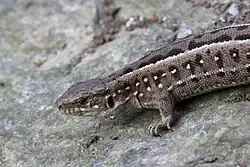
| Sand lizard (Lacerta agilis) | |
Scientific classification 
| |
| Kingdom: | Animalia |
| Phylum: | Chordata |
| Class: | Reptilia |
| Order: | Squamata |
| Suborder: | Lacertoidea |
| Family: | Lacertidae |
| Tribe: | Lacertini |
| Genus: | Linnaeus, 1758 |
| Type species | |
| Lacerta agilis | |
| Species | |
|
Ten, see text. | |
| |
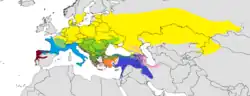
| Modern range of Lacerta species: L. agilis
L. bilineata
L. citrovittata
L. diplochondrodes
L. media
L. pamphylica
L. schreiberi
L. strigata
L. trilineata
L. viridis
| |
Lacerta is a genus of lizards of the family Lacertidae.
Taxonomy
Lacerta was a fairly diverse genus containing around 40 species, until it was split into nine genera in 2007 by Arnold, Arribas & Carranza.[1]
Fossil record
The earliest known members of the genus Lacerta are known from early Miocene epoch fossils indistinguishable in anatomy from the modern green lizards such as Lacerta viridis.[2] Some fossil species from the ice-age mediterranean, such as Lacerta siculimelitensis, reached especially large sizes.[3]
Species
The genus Lacerta contains the following species.[4]
| Image | Name | Distribution |
|---|---|---|
|
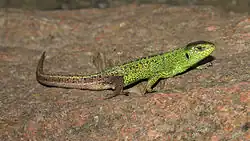
Lacerta agilis – sand lizard | 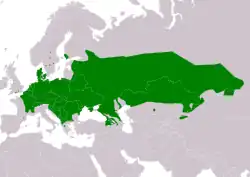
|
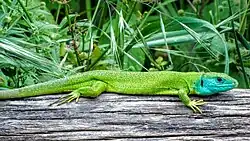
|
Lacerta bilineata – western green lizard | 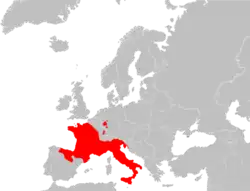
|
| Lacerta citrovittata – Tinos green lizard | Greece | |
| Lacerta diplochondrodes – Rhodos green lizard | Greece | |
|
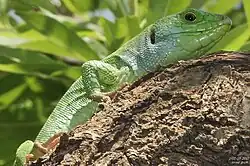
Lacerta media | Georgia, Armenia, Azerbaijan, Iran, |
.jpg)
|
Lacerta pamphylica | Turkey |

|
Lacerta schreiberi – Iberian emerald lizard | 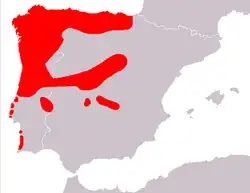
|
| Lacerta strigata – Caucasus emerald lizard | Georgia, Armenia, Azerbaijan,
Turkmenistan, Turkey and Iran | |
.jpg)
|
Lacerta trilineata – Balkan green lizard | 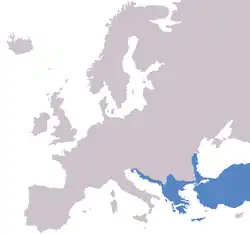
|
|
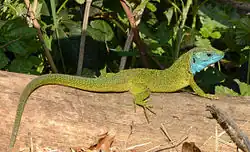
Lacerta viridis – European green lizard | 
|
Some species formerly in Lacerta
Arranged alphabetically by specific name:
- Anatololacerta anatolica – Anatolian rock lizard
- Atlantolacerta andreanskyi – Atlas dwarf lizard, Andreansky's lizard
- Iberolacerta aranica – Aran rock lizard
- Iberolacerta aurelioi – Aurelio's rock lizard
- Archaeolacerta bedriagae – Bedriaga's rock lizard
- Iberolacerta bonnali – Pyrenean rock lizard
- Apathya cappadocica – Anatolian lizard
- Darevskia chlorogaster – Green-bellied lizard[5]
- Phoenicolacerta cyanisparsa
- Omanosaura cyanura – blue-tailed Oman lizard
- Anatololacerta danfordi – Danford's lizard
- Darevskia defilippii – Elburs lizard
- Darevskia dryada (Darevsky & Tuniyev, 1997)
- Teira dugesii – Madeiran wall lizard
- Geosaurus giganteus
- Hellenolacerta graeca – Greek rock lizard
- Iberolacerta horvathi – Horvath's rock lizard
- Omanosaura jayakari – Jayakar's lizard
- Phoenicolacerta kulzeri
- Phoenicolacerta laevis – Lebanon lizard
- Timon lepidus – ocellated lizard, foot lizard
- Iberolacerta monticola – Iberian rock lizard
- Dinarolacerta mosorensis - Mosor rock lizard
- Podarcis muralis – common wall lizard
- Anatololacerta oertzeni[6]
- Dalmatolacerta oxycephala – sharp-snouted rock lizard
- Parvilacerta parva – dwarf lizard[7]
- Darevskia steineri
- Zootoca vivipara – viviparous lizard
- Iranolacerta zagrosica
References
- ^ Arnold, E. Nicholas; Arribas, Oscar; Carranza, Salvador (2007). "Systematics of the Palaearctic and Oriental lizard tribe Lacertini (Squamata: Lacertidae: Lacertinae), with descriptions of eight new genera" (PDF). Zootaxa. 1430. Auckland, New Zealand: Magnolia Press: 1–86. doi:10.11646/zootaxa.1430.1.1. ISBN 978-1-86977-097-6. Archived from the original (PDF) on 6 May 2021. Retrieved 12 July 2017.
- ^ Čerňanský A. 2010. "Earliest world record of green lizards (Lacertilia, Lacertidae) from the Lower Miocene of Central Europe". Biologia 65 (4): 737-741. doi:10.2478/s11756-010-0066-y
- ^ Böhme, Wolfgang; Zammit-Maempel, George (1982). "Lacerta siculimelitensis sp. n. (Sauria: Lacertidae), a giant lizard from the Late Pleistocene of Malta". Amphibia-Reptilia. 3 (2): 257–268. doi:10.1163/156853882X00473. Retrieved 4 November 2023.
- ^ "Lacerta ". The Reptile Database. www.reptile-database.org.
- ^ Tuniyev, B.; Ananjeva, N.B.; Agasyan, A.; Orlov, N.L.; Tuniyev, S.; Anderson, S. (2017) [errata version of 2009 assessment]. "Darevskia chlorogaster". IUCN Red List of Threatened Species. 2009: e.T164702A114559582. doi:10.2305/IUCN.UK.2009.RLTS.T164702A5919117.en. Retrieved 16 January 2020.
- ^ Wolfgang Böhme; Petros Lymberakis; Varol Tok; Ismail H. Ugurtas; Murat Sevinç; Pierre-André Crochet; Yakup Kaska; Yusuf Kumlutaş; Uğur Kaya; Aziz Avci; Nazan Üzüm; Can Yeniyurt; Ferdi Akarsu; Petros Lymberakis (2009). "Anatololacerta oertzeni". IUCN Red List of Threatened Species. 2009: e.T61527A12504829. doi:10.2305/IUCN.UK.2009.RLTS.T61527A12504829.en. Retrieved 16 January 2020.
- ^ Varol Tok; Ishmail Ugurtas; Murat Sevinç; Wolfgang Böhme; Pierre-André Crochet; Ferdi Akarsu (2009). "Parvilacerta parva". IUCN Red List of Threatened Species. 2009: e.T164674A5917051. doi:10.2305/IUCN.UK.2009.RLTS.T164674A5917051.en. Retrieved 16 January 2020.
Further reading
- Arnold EN, Arribas OJ, Carranza S. 2007. "Systematics of the Palaearctic and Oriental lizard tribe Lacertini (Squamata: Lacertidae: Lacertinae), with descriptions of eight new genera". Zootaxa 1430: 1-86.
- Linnaeus C. 1758. Systema naturae per regna tria naturae, secundum classes, ordines, genera, species, cum characteribus, differentiis, synonymis, locis. Tomus I. Editio Decima, Reformata. Stockholm: L. Salvius. 824 pp. (Lacerta, new genus, p. 200). (in Latin).