Oryza barthii
| Oryza barthii | |
|---|---|
Scientific classification 
| |
| Kingdom: | Plantae |
| Clade: | Tracheophytes |
| Clade: | Angiosperms |
| Clade: | Monocots |
| Clade: | Commelinids |
| Order: | Poales |
| Family: | Poaceae |
| Genus: | Oryza |
| Species: | O. barthii
|
| Binomial name | |
| Oryza barthii | |
| |
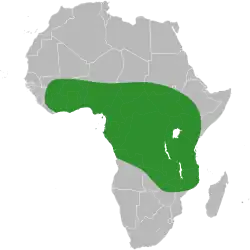
| The range of Oryza barthii. | |
| Synonyms[2] | |
| |

Oryza barthii, also called Barth's rice,[3] wild rice,[4] or African wild rice,[5] is a grass in the rice genus Oryza. It is an annual, erect to semierect grass. It has leaves with a short ligule (<13 millimetres (33⁄64 in)), and panicles that are compact to open, rarely having secondary branching. The inflorescence structure are large spikelets, 7.7–12.3 millimetres (39⁄128–31⁄64 in) long and 2.3–3.5 millimetres (23⁄256–35⁄256 in) wide, with strong awns (up to 20 centimetres (8 in) long), usually red. The inflorescences have anthers 1.5–3 millimetres (15⁄256–15⁄128 in) long.
This wild rice grows in sub-Saharan Africa, and is found in mopane or savanna woodland, savanna or fadama. O. barthii grows in deep water, seasonally flooded land, stagnant water, and slowly flowing water or pools; it prefers clay or black cotton soils (vertisol), and is found in open habitats.[6] It is the progenitor of cultivated Oryza glaberrima, African rice.[7][8]
It has nodal roots hosting nitrogen fixing, photosynthetic strains of Bradyrhizobium.[9]
The sequenced genome of O. barthii was published in 2014.[10] This species is one of the AA species, the domesticated rices and their wild relatives.[8]
Distribution
O. barthii is primarily found in West Africa.[8]
References
- ^ Phillips, J.; Yang, L.; Mani, S.; Vaughan, D. (2017). "Oryza barthii". IUCN Red List of Threatened Species. 2017: e.T177184A1471268. doi:10.2305/IUCN.UK.2017-3.RLTS.T177184A1471268.en. Retrieved 10 December 2022.
- ^ "The Plant List: A Working List of All Plant Species".
- ^ NRCS. "Oryza barthii". PLANTS Database. United States Department of Agriculture (USDA). Retrieved 25 July 2015.
- ^ "Oryza barthii". Germplasm Resources Information Network. Agricultural Research Service, United States Department of Agriculture. Retrieved 16 January 2018.
- ^ "NCBI Taxonomy".
- ^ Rice Knowledge Bank, Wild Rice Taxonomic information, accessed 12.18.2007. [1] Archived March 13, 2007, at the Wayback Machine
- ^ Linares 2002, African rice (Oryza glaberrima): History and future potential PNAS 99:16360-16365.
- ^ a b c Chen, Erwang; Huang, Xuehui; Tian, Zhixi; Wing, Rod A.; Han, Bin (2019-04-29). "The Genomics of Oryza Species Provides Insights into Rice Domestication and Heterosis". Annual Review of Plant Biology. 70 (1). Annual Reviews: 639–665. doi:10.1146/annurev-arplant-050718-100320. ISSN 1543-5008.
- ^ Chaintreuil, Clémence; Giraud, Eric; Prin, Yves; Lorquin, Jean; Bâ, Amadou; Gillis, Monique; de Lajudie, Philippe; Dreyfus, Bernard (December 2000). "Photosynthetic Bradyrhizobia Are Natural Endophytes of the African Wild Rice Oryza breviligulata". Applied and Environmental Microbiology. 66 (12): 5437–5447. doi:10.1128/AEM.66.12.5437-5447.2000. PMC 92479. PMID 11097925. Retrieved 7 May 2021.
- ^ Zhang, QJ.; Zhu, T.; Xia, EH.; Shi, C.; Liu, YL.; Zhang, Y.; Liu, Y.; Jiang, WK.; et al. (Nov 2014). "Rapid diversification of five Oryza AA genomes associated with rice adaptation". Proc Natl Acad Sci U S A. 111 (46): E4954 – E4962. doi:10.1073/pnas.1418307111. PMC 4246335. PMID 25368197.
External links