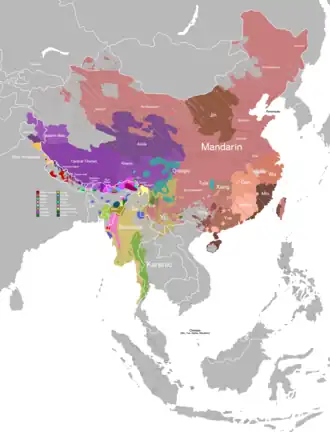
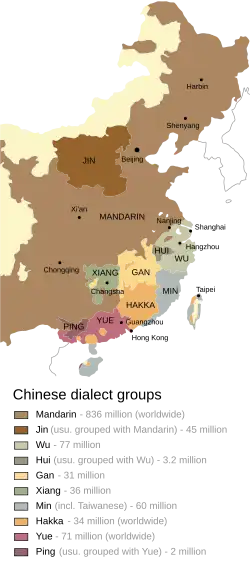
Badong Yao (Chinese: 八垌瑶语) is an unclassified Sinitic language spoken by the Yao people in Xinning County, Hunan province, China. Badong Yao is currently endangered, and is spoken in the villages of Huangyandong 黄岩峒, Malindong 麻林峒, and Dazhendong 大圳峒 in Huangjin Ethnic Yao Township 黄金瑶族乡, Xinning County.[1] It is also spoken in Malin Ethnic Yao Township 麻林瑶族乡, located just to the east of Huangjin Township.
It is documented in detail as Malinhua 麻林话 by Hu (2018).[2]
Vocabulary
The following word list of Badong Yao is from Li (2011:332-334).[3]
| Chinese gloss |
English gloss |
Badong Yao 八峒瑶 |
Page
|
| 硬 |
hard, stiff |
ŋai¹¹ |
332
|
| 牛 |
cattle |
ŋau¹³ |
332
|
| 你 |
you (singular) |
ŋ̩³³ |
332
|
| 一 |
one |
i⁵⁵ |
333
|
| 二 |
two |
liə¹¹ |
333
|
| 三 |
three |
sa³⁵ |
333
|
| 四 |
four |
ɕi⁵⁵ |
333
|
| 五 |
five |
ɤŋ³³ |
333
|
| 六 |
six |
lei³³ |
333
|
| 七 |
seven |
tɕʰi⁵⁵ |
333
|
| 八 |
eight |
pia³³ |
333
|
| 九 |
nine |
tɕy³³ |
333
|
| 十 |
ten |
dzi¹¹ |
333
|
| 百 |
hundred |
pa³³ |
333
|
| 千 |
thousand |
tsʰai³⁵ |
333
|
| 万 |
million |
uai¹¹ |
333
|
| 亿 |
hundred million |
i³⁵ |
333
|
| 斤 |
jin (Chinese measurement) |
tɕin³⁵ |
333
|
| 两 |
double |
lio³³ |
333
|
| 个 |
classifier (general) |
kəu³³ |
333
|
| 只 |
classifier (animals, pieces) |
tɕa³³ |
333
|
| 蔸 |
root and stem of certain plants |
tau³⁵ |
333
|
| 条 |
classifier (thin, long objects) |
dy¹³ |
333
|
| 根 |
root |
ɣai¹³ |
333
|
| 丈 |
husband |
dio³³ |
333
|
| 尺 |
chi (Chinese measurement) |
tsʰa³³ |
333
|
| 里 |
li (Chinese measurement) |
li³³ |
333
|
| 天 |
sky |
tʰiə³⁵ |
333
|
| 地 |
ground |
ti¹¹ |
333
|
| 人 |
person, human being |
ɤŋ¹³ |
333
|
| 云 |
cloud |
ɣoŋ³³ |
333
|
| 雨 |
rain |
u³³ |
333
|
| 霜 |
frost |
ɕio³⁵ |
333
|
| 东 |
east |
toŋ³⁵ |
333
|
| 南 |
south |
la³³ |
333
|
| 西 |
west |
ɕi³⁵ |
333
|
| 北 |
north |
pai³³ |
333
|
| 春 |
spring |
tɕʰoŋ³⁵ |
333
|
| 夏 |
summer |
xa¹¹ |
333
|
| 秋 |
autumn |
tsʰei³⁵ |
333
|
| 冬 |
winter |
toŋ³⁵ |
333
|
| 鸡 |
chicken |
tɕi³⁵ |
333
|
| 狗 |
dog |
kau³³ |
333
|
| 跳 |
to jump |
tʰei³³ |
333
|
| 打 |
to hit |
dei³³ |
333
|
| 抬 |
to lift |
diəa³³ |
333
|
| 爬 |
to climb |
la³³ |
333
|
| 快 |
fast |
kʰəa³³ |
333
|
| 慢 |
slow |
mai¹¹ |
333
|
| 好 |
good |
xəu³³ |
333
|
| 坏 |
bad |
ya¹¹ |
333
|
| 黑 |
black |
xai³³ |
333
|
| 白 |
white |
ba¹¹ |
333
|
| 起床 |
to get up from bed |
di³³tɕʰi¹¹ |
333
|
| 洗脸 |
to wash face |
ɕiə³³miə¹³ |
333
|
| 梳头 |
to comb hair |
ɕy³⁵dau³³ |
333
|
| 炒菜 |
to stir-fry vegetables |
tsʰəu³³tɕʰəa⁵⁵³ |
333
|
| 吃亮堂饭(早饭) |
to eat breakfast |
y¹¹do¹³lo³⁵pai¹¹ |
333
|
| 喂猪 |
to feed pig |
ui⁵⁵tei³⁵ |
333
|
| 看牛 |
to tend cattle |
lei⁵⁵ŋao³³ |
333
|
| 弄柴 |
to prepare firewood |
ləu³⁵dʑəa³³ |
333
|
| 烧火 |
to burn fire |
ɕy³⁵fəu³³ |
333
|
| 吃半日饭(中午饭) |
to eat lunch |
y¹¹po⁵⁵ɣoŋ³³pai¹¹ |
333
|
| 挑水 |
to carry water |
ta³⁵ɕui³³ |
333
|
| 洗衣 |
to wash clothes |
ɕiə³³i³⁵ |
333
|
| 缝衣 |
to sew clothes |
lai³³i³⁵ |
333
|
| 洗澡 |
to take a bath |
ba¹³duo¹³ |
333
|
| 吃夜头饭 |
to eat dinner |
yi¹¹ia¹¹dau³³pai¹¹ |
333
|
| 穿衣 |
to wear clothes |
təu³³i³⁵ |
333
|
| 穿裤 |
to wear pants |
bəu¹³fu⁵⁵ |
333
|
| 穿鞋 |
to wear shoes |
da¹¹iəa¹³ |
333
|
| 戴帽子 |
to wear hat |
tia⁵⁵mo³³tə¹⁰ |
333
|
| 睡觉 |
to sleep |
miə³³ŋo¹³tɕo¹⁰ |
333
|
| 自己 |
self (reflexive) |
tɕiə¹¹ka³⁵ |
334
|
| 我们 |
we (exclusive) |
a³³li³⁵ |
334
|
| 他们 |
they |
tʰaŋ³⁵li¹⁰ |
334
|
| 大家 |
everyone |
tɕin¹¹ɕi⁵⁵ |
334
|
| 老女(妻子) |
old woman (wife) |
ləu³³ny³⁵ |
334
|
| 主家人(丈夫) |
head of household (husband) |
tɕəu³³ka³⁵ɤŋ¹³ |
334
|
References
- ^ Lei Biying; Zheng Linguang [雷碧英; 郑林光; 新宁县民族宗教事务局; 新宁县黄金瑶族乡中心学校]. 2012. Badong Yao language [八峒瑶语]. Xinning: Xinning County Ethnic and Religious Affairs Bureau [新宁县民族宗教事务局].
- ^ Hu, Ping 胡萍 (2018). Yuyan jiechu yu Xiangxinan Miao Yao Pinghua diaocha yanjiu 语言接触与湘西南苗瑤平话调查研究. Changsha: Yuelu shushe 岳麓书社. ISBN 9787553808710. OCLC 1073112896.
- ^ Li Zirong [李志荣] (ed). 2011. Hunan Yaozu [湖南瑶族]. Beijing: Ethnic Publishing House [民族出版社]. ISBN 978-7-105-11699-7
|
|---|
| Official | |
|---|
| Regional | |
|---|
| Indigenous | |
|---|
| Minority | |
|---|
Varieties of
Chinese | |
|---|
| Creole/Mixed | |
|---|
| Extinct | |
|---|
| Sign | |
|---|
- GX = Guangxi
- HK = Hong Kong
- MC = Macau
- NM = Inner Mongolia
- XJ = Xinjiang
- XZ = Tibet
|
|
|---|
|
|
|
History, phonology, and grammar |
|---|
|
|
Written Chinese and input methods |
|---|
|
|
|